Numbered marbles from Vervoz
Numbered marbles from Vervoz (Clavier, Liège)
Terracotta
Late 1st century or early 2nd century AD
Department of Archaeology
Inv. I/3/31 to I/3/47, I/4/125, I/5/68 to I/5/70 and I/6/39
Between 1903 and 1906, the schoolteacher Firmin Hénaux, a corresponding member of the Liège Archaeological Institute, led, on behalf of the Institute, several excavation campaigns in the foundations of a Roman villa situated at a place known as ‘four à chaux’ in Vervoz, on either side of the road leading from Vervoz to Bois-et-Borsu.
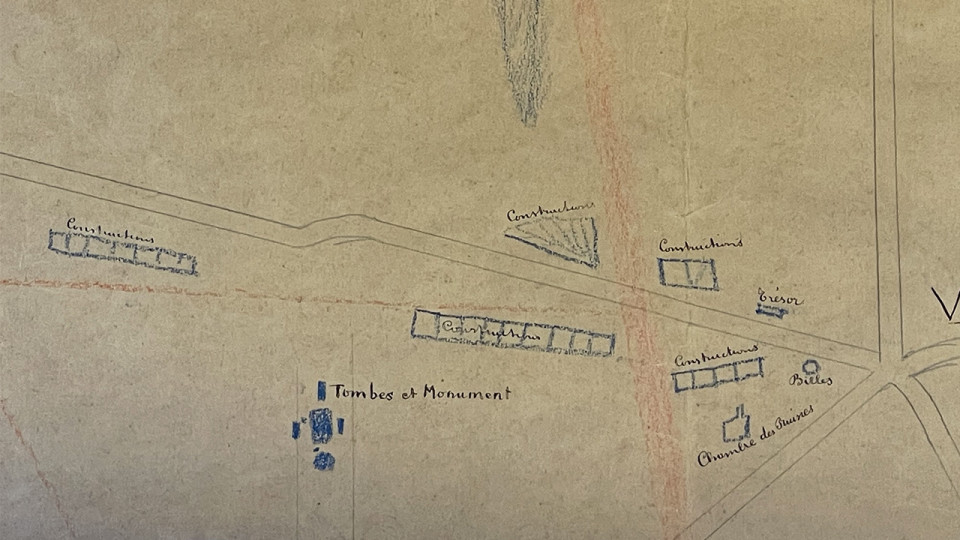
An anonymous sketch, presumably drawn by him in 1906, was discovered in the archives a few years ago (Fig. 1). This previously unpublished document shows the substructures uncovered during the various excavation campaigns – notably the foundations of three rectangular buildings – as well as the site where a hoard of coins (the Clavier I hoard) was unearthed in 1900, comprising 98 coins dating from the reigns of Augustus (27 BC –14 AD) to Arcadius (395–408 AD), as well as the location where various terracotta balls were unearthed. Also shown on this map, approximately 500 metres from the Roman villa, is the Vervoz funerary complex (a mausoleum surrounded by a small family necropolis from the Flavian period), excavated by F. Hénaux in August 1905.
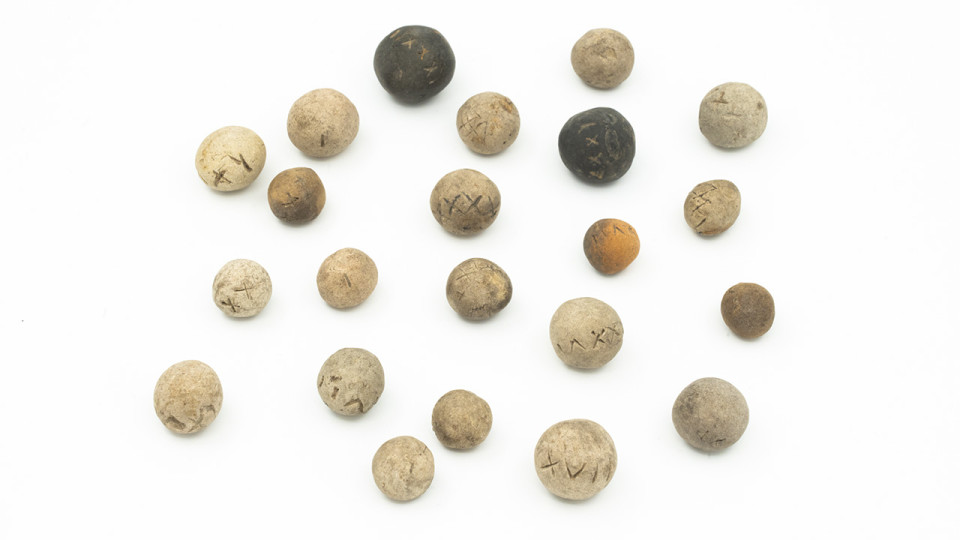
Among the abundant archaeological finds discovered in the remains of the Roman villa is an unusual series of 22 terracotta balls (17 unearthed in 1903, 1 in 1904, 3 in 1905 and 1 in 1906) of non-standardised dimensions (their diameter ranges from 1.4 to 2.1 cm and their weight varies between 3.09 and 10.66 g), marked with the following Roman numerals incised with a dry point before firing: I, I, I, XIII, XVII, XX, XXX, XXXVII, XXXVIII, XXXXI, XXXXI, LX, LXV, LXVI, LXVII, LXXX, LXXXIII, LXXXIIII, LXXXVI, LXXXVI, LXXXXV and LXXXXVI (1, 1, 1, 13, 17, 20, 30, 37, 38, 41, 41, 60, 65, 66, 67, 80, 83, 84, 86, 86, 95 and 96).
Undoubtedly unique in Belgium, these numbered beads have been found in the Treverian region at the Martberg oppidum, near Pommern (Rhineland-Palatinate, Germany), where a total of 27 numbered marbles have been discovered (18 during earlier excavations between 1885 and 1889/1890 and 9 during excavations carried out between 1997 and 2004), mostly inside and beneath the gallery of a temple. They bear a number ranging from II to LXXXXIX (2 to 99). Other examples were discovered at Karden, below the Martberg oppidum. These comprise three numbered spheres from a temple, bearing the numbers LXXI, LXXXXIIII and CI (71, 94 and 101). In Hesse, 34 numbered spheres – engraved with numbers ranging from VI to CI (6 to 101) – were discovered at Nida-Heddernheim (Frankfurt).
Based on these discoveries, there must originally have been three distinct sets of marbles ranging from the number I to CI. In Germany, no marble number ever repeats within the same series. But in Vervoz, we have the number I three times!
Several hypotheses have been put forward to explain the function of these numbered spheres:
- a kind of ‘lottery’ with an oracular nature;
- implements (pilae) used for drawing lots (sortitio) for electoral purposes;
- implements used for drawing lots to select members of the Ordo decurionum¹ responsible for performing rituals in the cities.
Jean-Luc Schütz
Curator of the Department of Archaeology
Exhibition location
The objects are on display in the ‘Object of the Month’ showcase. Entrance hall of the Grand Curtius Museum in Liège.
Photo copyright: City of Liège – Grand Curtius